Are Safety Features on Dating Apps Helpful?

The hidden disconnect between safety features and online deception
By: Becky Berg | Independent Researcher | October 2025 - January 2026
Dating apps are relied upon as the vehicle for romantic connection.
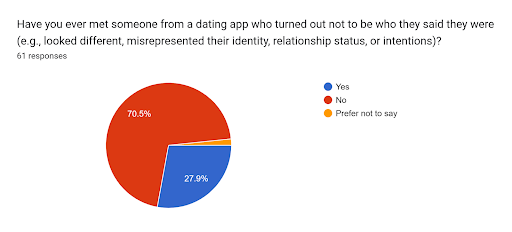
Yet, they are also the breeding grounds for online deception. When I asked participants in my study Bridging the Gap from Swiping to IRL how they determine whether someone is ‘real’ on a dating app:
Approximately 1 in 4 of them (28%) admitted experiencing online deception when they met their date in person.
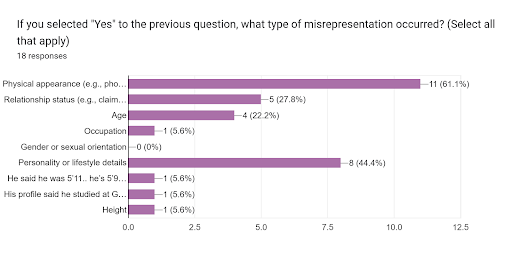
Of those who experienced the deception, a majority of them reported a misalignment in their date’s appearance or lifestyle details.
This raised an important question:
How can safety features help address the deception problem and increase platform trust?
Challenges Identified with Current Safety Features

Safety features are not widely known
Dating apps are developing nuanced safety tools to protect users; however, many of them go unnoticed.
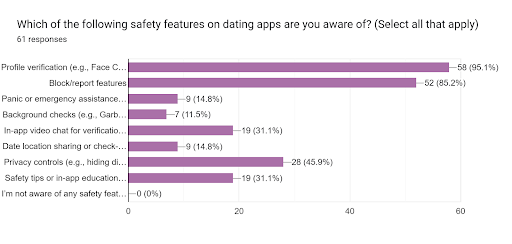
Participants in my study showed a high awareness of basic tools like:
profile verification
block/report features
But their awareness dropped sharply for more advanced safety features, such as:
safety alerts
panic buttons
background checks

They are underutilized
Even though several safety features exist, their actual use is not integrated into user behavior.
Participants on average rated their use of safety tools as less frequent (M = 2.75, SD = 1.27).
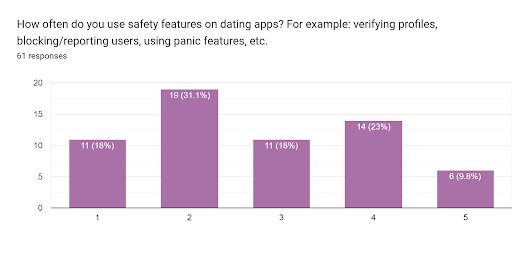
Rating from 1 (never) to 5 (always)

They are considered only moderately effective
Participant beliefs showed skepticism towards current safety features.
Participants rated the current safety features as moderately helpful during their dating app experience (M = 3.05, SD = 0.94).
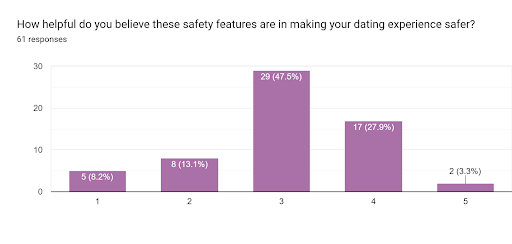
Rating from 1 (not helpful at all) to 5 (extremely helpful).

Key Insight
Together, these findings reveal a disconnect:
Safety features exist, but users aren’t fully aware of them or using them to their full potential.
This indicates that many participants perceive safety tools as an inherent background security system rather than as frontline protection.
With this belief, users may feel compelled to rely more on personal judgment and intuition rather than platform security efforts.
Recommendations for Dating Apps

Offer more with
less
Extensive protective measures do not yield a proportional outcome with user-perceived safety, as users don't use advanced features. Hence, dating apps must focus on providing more value with limited features.
For example, setting higher safeguards for verified, high-trust profiles to be pooled, eliminating the need for profile verifications and background checks.
Bring safety features to the forefront
Expose users to safety features via pop-ups in the platform interface or during onboarding demonstrations to increase their awareness.
Efforts to reduce deception will increase perceived safety.

Build trust with safety education
Safety features and messaging influence how users perceive the platform.
Changing user beliefs about the utility of safety features through supportive messaging and effective education can increase platform trust.
Downloadables and Research Materials
Note: Files are provided to demonstrate research rigor, transparency, and analytical workflow rather than for independent reuse. To balance transparency with participant privacy, select materials are publicly available, with additional documentation available upon request.
Study Instruments
Includes all measures collected for this study; select sections are analyzed in the present write-up. Additional analyses are forthcoming.
Data & Analysis
Cleaned/De-identified dataset - Available Upon Request
Sample R Analysis Scripts
Includes curated R scripts demonstrating quantitative and qualitative research workflows used in this study. Participant data intentionally excluded for privacy.
Analysis Outputs - Available Upon Request